
What the source data says
DP World positions Jebel Ali as a leading maritime hub and reports more than 80 weekly services connecting the port to more than 150 ports globally. Its terminal facts also list 5,000 metres of quay length, a 1.4 million sqm terminal area, 27 berths, and 1 million sqm of open and covered yard space.
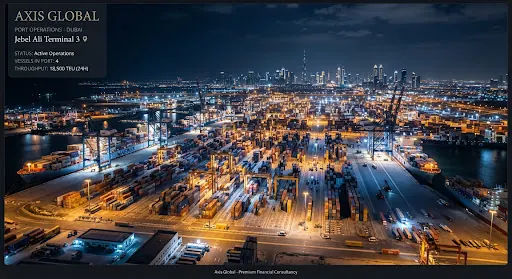
- 80+ weekly servicesService density improves corridor optionality but can also increase complexity in routing and cost-to-serve analysis.
- 150+ connected portsNetwork reach gives operators access to wider markets, making currency, counterparty, and receivables discipline more important.
- 1m sqm yard spaceYard capacity turns storage assumptions into a working-capital issue, not merely an operational planning point.
Financial implication
For logistics companies, the finance question extends beyond shipment cost. Route profitability must be examined alongside customs friction, storage duration, container dwell time, warehouse utilization, fleet commitments, demurrage exposure, and customer collection cycles.
A corridor may appear profitable on a gross-margin basis while still absorbing cash through delayed receivables, stock build-up, or inefficient inventory turns. That is why logistics financial consultancy must connect throughput assumptions to liquidity outcomes.
AXIS Global view
AXIS Global frames Jebel Ali-related logistics decisions through cash-conversion discipline. We test route economics, inventory dwell, storage exposure, disruption scenarios, and payment timing together so management can see where margin, cash flow, and growth capacity diverge.